
Holyoke Family Genealogy - Person Sheet
Holyoke Family Genealogy - Person Sheet
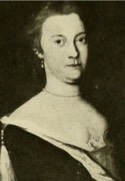
NameElizabeth BROWNE 
 , F
, F
, FBirth4 Feb 1691
Death15 Aug 1719, Marblehead, Essex, MA25
Baptism21 Feb 1691/92
BurialOld Burial Hill Cemetery; Marblehead, Essex, MA
FatherCapt. John BROWNE , M (1664-1707)
MotherElizabeth LEGG , F (1669-~1735)
Spouses
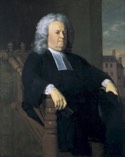
1Rev. Edward HOLYOKE 2,25,26, M
2,25,26, MBirth25 Jun 1689, Boston, Suffolk, MA
Death1 Jun 1769, Boston, Suffolk, MA
BurialCambridge Cemetery; Cambridge, Middlesex, MA
OccupationPresident of Harvard College, 1737 to 17692
FatherElizur HOLYOKE , Jr. , M (1651-1711)
MotherMary ELIOTT , F (1655-1721)
Family ID50
Marriage8 Aug 1717, Marblehead, Essex, MA
Notes for Elizabeth BROWNE
• Some records list her year of birth as “1692”
• Some record simply spell her last name as “Brown”
• Some record simply spell her last name as “Brown”
Notes for Edward (Spouse 1)
• Edward was educated at North Grammar School, Boston, and then went directly to Harvard College.
• Edward “had the distinction, as an undergraduate, of having more fines and black marks recorded against his name for breaches of discipline than any student of his day. But he had grown in time to be a good and wise man, pastor of the Marblehead congregation.”
• He graduated in 1705 at age 16, and gave the class a Bachelor's Oration and in 1708, he received his A.M. from Harvard College.
• From 1709-1712, he was the Librarian at Harvard, followed as a tutor (instructor) 1712-1716. On April 1714, he was chosen “a Fellow of the Corporation” (Harvard).
• In 1714, he also became a candidate for colleague pastor with Rev. Samuel Cheever of Marblehead, but the majority of the church favored another candidate (John Benard). The minority (that supported Holyoke) withdrew and formed a second church, which Edward was ordained as pastor on April 25, 1716, and served the church for 21 years.
• Holyoke was recommended, and then approved by Governor Belcher, as the choice for President of Harvard College. The General Court agreed to pay Marblehead Society 140 pounds "to encourage and facilitate the settlement of a new minister there ..." thereby allowing Holyoke to become the 9th President of Harvard College (1737 - 1769), succeeding after Benjamin Wadsworth’s death. The General Court granted Holyoke a salary of 200 pounds, plus rent of Massachusetts Hall.
• For 299 years (from 1672 to 1971), all the presidents of Harvard graduated from Harvard.
• He first attracted attention by his election-day sermon delivered before the Governor and General Court in 1736, in which he boldly declared: “All forms of government originate from the people . . . As these forms have originated from the people, doubtless they may be changed whensoever the body of them choose to make such an alteration.”
• Records for Holyoke's inauguration also provided the earliest evidence that of the singing of Psalm 78 ("Give ear, my Children"), which is now the traditional Harvard Commencement Psalm.
• By 1744, Holyoke was not only the President of Harvard, but he also became the chairman of the Harvard Corporation, meaning he was not only responsible for tutoring (Professor / Tutor and also Hebrew Instructor), but he also responsible for the day-to-day operation of the university. At that time, there was about 100 students, taught by the president and four tutors.
• Of special interest … Holyoke’s influence on the American Founders is hard to understate given a look at his life, and a review of the pupils who learned under his tutelage. All but one Massachusetts Revolutionary leader were students of Edward Holyoke; Samuel Adams (A.B), James Otis (A.B.), Jonathan Mayhew (A.B.), Thomas Cushing (A.B.), James Bowdoin (A.B.), John Hancock (A.B.), John Adams (A.B.), Joseph Warren (A.B.), and Josiah Quincy Jr. (A.B.). Other notable New England names were John Wentworth, Samuel Quincy, Moses Hemenway, Charles Cushing, Nathan Webb, William Browne, Philip Livingston, David Sewall, Daniel Treadwell, and Tristam Dalton.
• Samuel Adams - Class of 1740
Samuel Adams was the prototypical American rebel. Not particularly good at business, Adams sure knew how to cause a scene. He used his education to unite discontented Bostonians and start a revolution.
• James Otis - Class of 1743
James Otis joined Adams as one of the primary movers and shakers in the early days of rebellion. He was one of the most sought-after lawyers in Boston. His ability as an orator, merged with an understanding of the law, gave him an edge every time he stepped in the courtroom. He was also the Advocate General of the Admiralty Court of Massachusetts. In this position, he acted as an attorney general for all shipping and maritime cases … which is his connection to the Stamp Act Congress and he is often credited for coining the term ‘no taxation without representation.’
• Thomas Cushing - Class of 1744
Thomas Cushing would sign the Continental Association but refused to vote for independence. He was still a Patriot who helped organize the construction of ships for the Continental Navy as Commissioner of Marine Affairs. Later, he would serve as Lieutenant Governor of Massachusetts.
• James Bowdoin - Class of 1745
James Bowdoin was the head of the Massachusetts Provincial Congress at the start of the Revolutionary War. He would become the president of the constitutional convention that drafted the state's constitution in 1779, and then the second Governor of Massachusetts, during which time he suppressed Shays’ Rebellion. Bowdoin personally funded militia forces that were instrumental in putting down the uprising. His high-handed treatment of the rebels may have contributed to his loss of the 1787 governor’s election, in which the populist Hancock was returned to office.
• John Hancock - Class of 1754
John Hancock used his education to run one of the largest merchant firms in the colony. He then went on to be the longest-serving president of the Continental Congress, having served as the second president of the Second Continental Congress and the seventh president of the Congress of the Confederation. He was the first and third governor of the Commonwealth of Massachusetts.
• John Q Adams - Class of 1755
John Adams went on to sign the Declaration of Independence, serve as first Vice President of the United States, and then second President of the United States. But you knew that already.
• Joseph Warren - Class of 1759
Joseph Warren quickly ascended to the heights of what a Boston physician could be. He was an important leader early in the revolution and died as a martyr at the Battle of Bunker Hill.
• Holyoke's administration began during the religious revivals of the Great Awakening and lasted into the revolutionary controversy with England, which was entering its final phase at the time of his death. His opinions on religion and government are particularly important. “A liberal in politics, Holyoke was also an eloquent spokesman of the new spirit of toleration that was softening the strict tenets of New England Calvinism. In his speeches to ministers and pastors, he had insisted that governments “should have no hand in making any laws with regard to the spiritual affairs of their people . . . [and] have no right to impose their interpretations of the laws of Christ upon their flocks . . . Every man, therefore, is to judge for himself in these things.”
• Holyoke's presidency was not without some controversy. In the early 1740s, the revivalist George Whitefield came to Cambridge to preach. Although Holyoke at first welcomed Whitefield to Harvard College, he eventually turned against him because Holyoke perceived Whitefield's religious views as excessive, inspiring division among families and local churches. Moreover, Holyoke took exception to Whitefield's labeling of Harvard College as a house of impiety and sin. In 1744, Holyoke and other members of the faculty defended the college and warned the local churches against Whitefield's views in The Testimony of the President, Professors, Tutors, and Hebrew Instructor of Harvard College. This rebuttal to Whitefield sparked a year-long pamphlet war between both sides. Despite Holyoke's differences with George Whitefield, Whitefield came to the College's aid and donated books and money to help rebuild the library collection when a fire destroyed the College's original library twenty years later in 1764.
• Throughout the four years John Adams attended Harvard, the first Saturday of the month was given over to the study of theology under President Holyoke’s supervision.26
• Holyoke encouraged broader intellectual exploration well beyond curriculum and disciplinary changes. In 1755, he started the Dudleian Lecture (https://en.wikipedia.org/wiki/Dudleian_lectures) was given for the first time by the College. In 1756, in order to improve English oratory, a system of public exhibitions was also introduced. Lasting for over a century, selected students participated in debates, orations, and dialogues in the English language.
• Holyoke liberalized and strengthened Harvard’s academic program … during his administration, several reforms were undertaken to improve the intellectual climate at the College. The ancient system of each tutor taking a college class through all the subjects in a curriculum was ended. By 1767, tutors had become specialists instructing students in a particular subjects. Moreover, merit, rather than solely birth and social standing, became the criterion for entrance to Harvard College. College history prizes were offered for scholarships, and the custom of flogging students for college offenses was abandoned.
• Edward’s term in office was the longest in Harvard's history until Charles Eliot began his record-setting, forty-year presidency a century later. Holyoke is still considered the oldest person to occupy the presidency of Harvard.
• “The fact that Harvard had moved a long way from the strict faith of the fathers, under Holyoke’s “catholic temper,” all manner of heresies flourished, or if they were not encouraged, were not firmly suppressed, which left Yale as the only stronghold of orthodoxy.”
• While not considered an intellect by his contemporaries, Holyoke did strengthen Harvard’s academic program in mathematics and science, and during his tenure, Harvard established the first laboratory for experimental physics in North America. In 1761, John Winthrop, the Hollis Professor of Mathematics and Natural Philosophy, arranged the first American astronomical expedition to observe Venus's transit over the Sun.
• “Much was said, both in approval and censure of the President’s “catholic temper,” which soon affected the intellectual climate of the college. He had, moreover, “a good spirit of government.” Kindly, he was at the same time a firm disciplinarian, a man “of a noble commanding presence.” In his company, students must stand or uncover. His girth won him the irreverent student nickname of “guts.”
• He was characterized as an honest man of sound judgment and zealous in the performance of his duties. A man of learning with an ability to deal with a society of scholars, Holyoke's leadership led Harvard College through turbulent and changing times. Under his administration, Harvard College prospered and flourished. The number of students increased, gifts and endowments were added to the treasury, and intellectual training was improved. During Holyoke's tenure, the College itself also expanded. Holden Chapel (1744) and Hollis Hall (1763) were built. Furthermore, after Harvard Hall was destroyed by fire in 1764, it was rebuilt and completed in 1766.
• Speaking from his deathbed, Holyoke uttered an insight that still resonates in the ears of his successors: “If any man wishes to be humbled and mortified, let him become President of Harvard College.”
[S:9], [S:24], [S:26], [S:27], [S:166], [S: 216], [S:217], [S:218] 27 28 29, [S:249]30
Side-note …
Oliver Wendell Holmes … From "The Autocrat of the Breakfast Table"
The President's Chair
At Cambridge. Is kept in the College there.
Seems but little the worse for wear.
That's remarkable when I say
It was old in President Holyoke's day.
President Edward Holyoke bought the chair for the College. Where and how he got it, no one seems to know for sure. A late descendant of the great chairs once used by the masters of medieval households, Harvard's symbolic seat of authority seems to have inspired questions almost from the day it arrived. (Even in the usually calm, collected pages of an exhibition catalog, it is described as "… bizarre.") Holyoke himself recalled at least 50 occasions when he had to explain to a curious questioner that he knew nothing definite about the chair's history.
Historians of furniture believe that this "three-square turned chair" was made in England or Wales between 1550 and 1600. "However the chair was obtained for the college … it captured Holyoke's attention as an imposing, ancient and curious throne, suitable to the authority of the president and establishing an iconographic link between Harvard College and its late medieval English prototypes, Oxford and Cambridge," as Robert Trent observes in "New England Begins: The Seventeenth Century," the catalog to a 1982 exhibition in which the chair was shown at Boston's Museum of Fine Arts.
Holyoke gave the chair a personal Harvard touch by crowning the front posts with large, globular oak pommels of his own making. A 1976 microanalysis found that the rest of the chair is made of European ash (Fraxinus excelsior). Sitting for artist John Singleton Copley (ca. 1760), Holyoke became the first of several Harvard presidents (including Walker, Lowell, Conant, Pusey, Bok, and Rudenstine) to pose proudly - and uncomfortably - in the chair for their official oil portrait. Perhaps by striking their own precarious balance in this strange seat of authority, the successors of Edward Holyoke come to sense what the job is all about.
• Edward “had the distinction, as an undergraduate, of having more fines and black marks recorded against his name for breaches of discipline than any student of his day. But he had grown in time to be a good and wise man, pastor of the Marblehead congregation.”
• He graduated in 1705 at age 16, and gave the class a Bachelor's Oration and in 1708, he received his A.M. from Harvard College.
• From 1709-1712, he was the Librarian at Harvard, followed as a tutor (instructor) 1712-1716. On April 1714, he was chosen “a Fellow of the Corporation” (Harvard).
• In 1714, he also became a candidate for colleague pastor with Rev. Samuel Cheever of Marblehead, but the majority of the church favored another candidate (John Benard). The minority (that supported Holyoke) withdrew and formed a second church, which Edward was ordained as pastor on April 25, 1716, and served the church for 21 years.
• Holyoke was recommended, and then approved by Governor Belcher, as the choice for President of Harvard College. The General Court agreed to pay Marblehead Society 140 pounds "to encourage and facilitate the settlement of a new minister there ..." thereby allowing Holyoke to become the 9th President of Harvard College (1737 - 1769), succeeding after Benjamin Wadsworth’s death. The General Court granted Holyoke a salary of 200 pounds, plus rent of Massachusetts Hall.
• For 299 years (from 1672 to 1971), all the presidents of Harvard graduated from Harvard.
• He first attracted attention by his election-day sermon delivered before the Governor and General Court in 1736, in which he boldly declared: “All forms of government originate from the people . . . As these forms have originated from the people, doubtless they may be changed whensoever the body of them choose to make such an alteration.”
• Records for Holyoke's inauguration also provided the earliest evidence that of the singing of Psalm 78 ("Give ear, my Children"), which is now the traditional Harvard Commencement Psalm.
• By 1744, Holyoke was not only the President of Harvard, but he also became the chairman of the Harvard Corporation, meaning he was not only responsible for tutoring (Professor / Tutor and also Hebrew Instructor), but he also responsible for the day-to-day operation of the university. At that time, there was about 100 students, taught by the president and four tutors.
• Of special interest … Holyoke’s influence on the American Founders is hard to understate given a look at his life, and a review of the pupils who learned under his tutelage. All but one Massachusetts Revolutionary leader were students of Edward Holyoke; Samuel Adams (A.B), James Otis (A.B.), Jonathan Mayhew (A.B.), Thomas Cushing (A.B.), James Bowdoin (A.B.), John Hancock (A.B.), John Adams (A.B.), Joseph Warren (A.B.), and Josiah Quincy Jr. (A.B.). Other notable New England names were John Wentworth, Samuel Quincy, Moses Hemenway, Charles Cushing, Nathan Webb, William Browne, Philip Livingston, David Sewall, Daniel Treadwell, and Tristam Dalton.
• Samuel Adams - Class of 1740
Samuel Adams was the prototypical American rebel. Not particularly good at business, Adams sure knew how to cause a scene. He used his education to unite discontented Bostonians and start a revolution.
• James Otis - Class of 1743
James Otis joined Adams as one of the primary movers and shakers in the early days of rebellion. He was one of the most sought-after lawyers in Boston. His ability as an orator, merged with an understanding of the law, gave him an edge every time he stepped in the courtroom. He was also the Advocate General of the Admiralty Court of Massachusetts. In this position, he acted as an attorney general for all shipping and maritime cases … which is his connection to the Stamp Act Congress and he is often credited for coining the term ‘no taxation without representation.’
• Thomas Cushing - Class of 1744
Thomas Cushing would sign the Continental Association but refused to vote for independence. He was still a Patriot who helped organize the construction of ships for the Continental Navy as Commissioner of Marine Affairs. Later, he would serve as Lieutenant Governor of Massachusetts.
• James Bowdoin - Class of 1745
James Bowdoin was the head of the Massachusetts Provincial Congress at the start of the Revolutionary War. He would become the president of the constitutional convention that drafted the state's constitution in 1779, and then the second Governor of Massachusetts, during which time he suppressed Shays’ Rebellion. Bowdoin personally funded militia forces that were instrumental in putting down the uprising. His high-handed treatment of the rebels may have contributed to his loss of the 1787 governor’s election, in which the populist Hancock was returned to office.
• John Hancock - Class of 1754
John Hancock used his education to run one of the largest merchant firms in the colony. He then went on to be the longest-serving president of the Continental Congress, having served as the second president of the Second Continental Congress and the seventh president of the Congress of the Confederation. He was the first and third governor of the Commonwealth of Massachusetts.
• John Q Adams - Class of 1755
John Adams went on to sign the Declaration of Independence, serve as first Vice President of the United States, and then second President of the United States. But you knew that already.
• Joseph Warren - Class of 1759
Joseph Warren quickly ascended to the heights of what a Boston physician could be. He was an important leader early in the revolution and died as a martyr at the Battle of Bunker Hill.
• Holyoke's administration began during the religious revivals of the Great Awakening and lasted into the revolutionary controversy with England, which was entering its final phase at the time of his death. His opinions on religion and government are particularly important. “A liberal in politics, Holyoke was also an eloquent spokesman of the new spirit of toleration that was softening the strict tenets of New England Calvinism. In his speeches to ministers and pastors, he had insisted that governments “should have no hand in making any laws with regard to the spiritual affairs of their people . . . [and] have no right to impose their interpretations of the laws of Christ upon their flocks . . . Every man, therefore, is to judge for himself in these things.”
• Holyoke's presidency was not without some controversy. In the early 1740s, the revivalist George Whitefield came to Cambridge to preach. Although Holyoke at first welcomed Whitefield to Harvard College, he eventually turned against him because Holyoke perceived Whitefield's religious views as excessive, inspiring division among families and local churches. Moreover, Holyoke took exception to Whitefield's labeling of Harvard College as a house of impiety and sin. In 1744, Holyoke and other members of the faculty defended the college and warned the local churches against Whitefield's views in The Testimony of the President, Professors, Tutors, and Hebrew Instructor of Harvard College. This rebuttal to Whitefield sparked a year-long pamphlet war between both sides. Despite Holyoke's differences with George Whitefield, Whitefield came to the College's aid and donated books and money to help rebuild the library collection when a fire destroyed the College's original library twenty years later in 1764.
• Throughout the four years John Adams attended Harvard, the first Saturday of the month was given over to the study of theology under President Holyoke’s supervision.26
• Holyoke encouraged broader intellectual exploration well beyond curriculum and disciplinary changes. In 1755, he started the Dudleian Lecture (https://en.wikipedia.org/wiki/Dudleian_lectures) was given for the first time by the College. In 1756, in order to improve English oratory, a system of public exhibitions was also introduced. Lasting for over a century, selected students participated in debates, orations, and dialogues in the English language.
• Holyoke liberalized and strengthened Harvard’s academic program … during his administration, several reforms were undertaken to improve the intellectual climate at the College. The ancient system of each tutor taking a college class through all the subjects in a curriculum was ended. By 1767, tutors had become specialists instructing students in a particular subjects. Moreover, merit, rather than solely birth and social standing, became the criterion for entrance to Harvard College. College history prizes were offered for scholarships, and the custom of flogging students for college offenses was abandoned.
• Edward’s term in office was the longest in Harvard's history until Charles Eliot began his record-setting, forty-year presidency a century later. Holyoke is still considered the oldest person to occupy the presidency of Harvard.
• “The fact that Harvard had moved a long way from the strict faith of the fathers, under Holyoke’s “catholic temper,” all manner of heresies flourished, or if they were not encouraged, were not firmly suppressed, which left Yale as the only stronghold of orthodoxy.”
• While not considered an intellect by his contemporaries, Holyoke did strengthen Harvard’s academic program in mathematics and science, and during his tenure, Harvard established the first laboratory for experimental physics in North America. In 1761, John Winthrop, the Hollis Professor of Mathematics and Natural Philosophy, arranged the first American astronomical expedition to observe Venus's transit over the Sun.
• “Much was said, both in approval and censure of the President’s “catholic temper,” which soon affected the intellectual climate of the college. He had, moreover, “a good spirit of government.” Kindly, he was at the same time a firm disciplinarian, a man “of a noble commanding presence.” In his company, students must stand or uncover. His girth won him the irreverent student nickname of “guts.”
• He was characterized as an honest man of sound judgment and zealous in the performance of his duties. A man of learning with an ability to deal with a society of scholars, Holyoke's leadership led Harvard College through turbulent and changing times. Under his administration, Harvard College prospered and flourished. The number of students increased, gifts and endowments were added to the treasury, and intellectual training was improved. During Holyoke's tenure, the College itself also expanded. Holden Chapel (1744) and Hollis Hall (1763) were built. Furthermore, after Harvard Hall was destroyed by fire in 1764, it was rebuilt and completed in 1766.
• Speaking from his deathbed, Holyoke uttered an insight that still resonates in the ears of his successors: “If any man wishes to be humbled and mortified, let him become President of Harvard College.”
[S:9], [S:24], [S:26], [S:27], [S:166], [S: 216], [S:217], [S:218] 27 28 29, [S:249]30
Side-note …
Oliver Wendell Holmes … From "The Autocrat of the Breakfast Table"
The President's Chair
At Cambridge. Is kept in the College there.
Seems but little the worse for wear.
That's remarkable when I say
It was old in President Holyoke's day.
President Edward Holyoke bought the chair for the College. Where and how he got it, no one seems to know for sure. A late descendant of the great chairs once used by the masters of medieval households, Harvard's symbolic seat of authority seems to have inspired questions almost from the day it arrived. (Even in the usually calm, collected pages of an exhibition catalog, it is described as "… bizarre.") Holyoke himself recalled at least 50 occasions when he had to explain to a curious questioner that he knew nothing definite about the chair's history.
Historians of furniture believe that this "three-square turned chair" was made in England or Wales between 1550 and 1600. "However the chair was obtained for the college … it captured Holyoke's attention as an imposing, ancient and curious throne, suitable to the authority of the president and establishing an iconographic link between Harvard College and its late medieval English prototypes, Oxford and Cambridge," as Robert Trent observes in "New England Begins: The Seventeenth Century," the catalog to a 1982 exhibition in which the chair was shown at Boston's Museum of Fine Arts.
Holyoke gave the chair a personal Harvard touch by crowning the front posts with large, globular oak pommels of his own making. A 1976 microanalysis found that the rest of the chair is made of European ash (Fraxinus excelsior). Sitting for artist John Singleton Copley (ca. 1760), Holyoke became the first of several Harvard presidents (including Walker, Lowell, Conant, Pusey, Bok, and Rudenstine) to pose proudly - and uncomfortably - in the chair for their official oil portrait. Perhaps by striking their own precarious balance in this strange seat of authority, the successors of Edward Holyoke come to sense what the job is all about.